Furnace Installation Cost in Winnipeg
What you'll actually pay to replace a furnace in Winnipeg - including the variables that move the number up or down significantly.
Most Winnipeg homeowners replace a furnace once, maybe twice in a lifetime - which means there's no frame of reference when the time actually comes. Quotes vary, companies quote in acronyms, and it's hard to know whether $6,500 is reasonable or inflated. This guide breaks down what you're actually paying for, what drives costs up, and what questions to ask before you sign anything.
What Furnace Installation Costs in Winnipeg: The Ranges
The honest answer is that furnace installation in Winnipeg spans a wide range depending on the equipment and your home's existing setup. Here's where most jobs land:
| Furnace Type | Efficiency | Installed Cost (Winnipeg) |
|---|---|---|
| High-efficiency gas furnace | 95–96% AFUE | $4,500 – $8,000 |
Since July 2019, Canada's Energy Efficiency Regulations require a new gas furnace for a house to be at least 95% AFUE; lower-efficiency (80%) units are allowed only in narrow cases such as manufactured homes. Installed cost includes equipment, labour, permit, and standard venting. Homes requiring ductwork modifications, gas line changes, or electrical upgrades will be on the higher end.
Replacing the furnace and air conditioner together? Using the ranges on this site, a new furnace ($4,500–$8,000) plus a new central air conditioner on existing ductwork ($3,500–$7,000) comes to roughly $8,000–$15,000 installed. Doing both in one visit can trim some labour and makes sure the new AC coil is matched to the new furnace, so ask for a combined quote. If the AC is due as well, price a cold-climate heat pump in its place: it cools in summer, supplies some of the heat in spring and fall, and a centrally ducted one qualifies for a $2,000 Efficiency Manitoba rebate. See the Winnipeg heat pump guide.
Labour typically accounts for $800–$1,800 of the total. The rest is equipment and materials. Quotes that seem unusually low often compress labour - which can mean faster work, fewer checks, or unlicensed technicians.
The fall startup scenario: One of the most common furnace calls in Winnipeg comes in mid-October - the homeowner turns the heat on for the first time since spring and gets cold air, no ignition, or nothing at all. A failed igniter, a dirty flame sensor, or a tripped pressure switch are the usual culprits. A diagnostic call in the first week of heating season tells you whether you're looking at a $200 repair or a furnace that's overdue for replacement.
What Moves the Price Up or Down
The two furnace types above are the starting point. What takes a job from the low end of the range to the high end is almost always one of the following, each priced separately on a good quote:
| Item | Typical added cost | When it applies |
|---|---|---|
| Ductwork modifications | $500 – $2,000 | Older or undersized ducts, or a new unit with different connection sizes |
| Gas line upgrade | $300 – $700 | Existing gas supply line is too small for the new unit |
| Electrical work | Quoted per job | No dedicated circuit, or the panel lacks capacity |
| Smart thermostat | $150 – $350 | Optional upgrade from the basic thermostat |
If every priced add-on applied to a high-efficiency install, the sum would run from about $5,450 to $11,050. That is a worst case, not a typical job. Labour accounts for roughly $800 to $1,800 of the total in each case.
Two other things change the price without appearing as a line item: the brand and model line (the same efficiency rating can cost noticeably different amounts), and features such as two-stage or modulating burners and variable-speed blowers. Those features cost more up front and tend to make the house more even and the furnace quieter. Ask for the price difference between the models as a separate line, so you can decide whether the comfort features are worth it to you.
Sizing, Venting and Cold-Climate Details
Ask for a heat-loss calculation. A furnace should be sized to the house, not simply to match the old unit. Canada has a standard method for calculating a home's heating and cooling loads (CSA F280), and a contractor who has measured your house and run the numbers can justify the size they recommend. Many Winnipeg homes have been re-insulated or had windows replaced since the original furnace went in, which can mean the old unit was oversized for the house as it is today. An oversized furnace short-cycles, wears parts faster and heats unevenly.
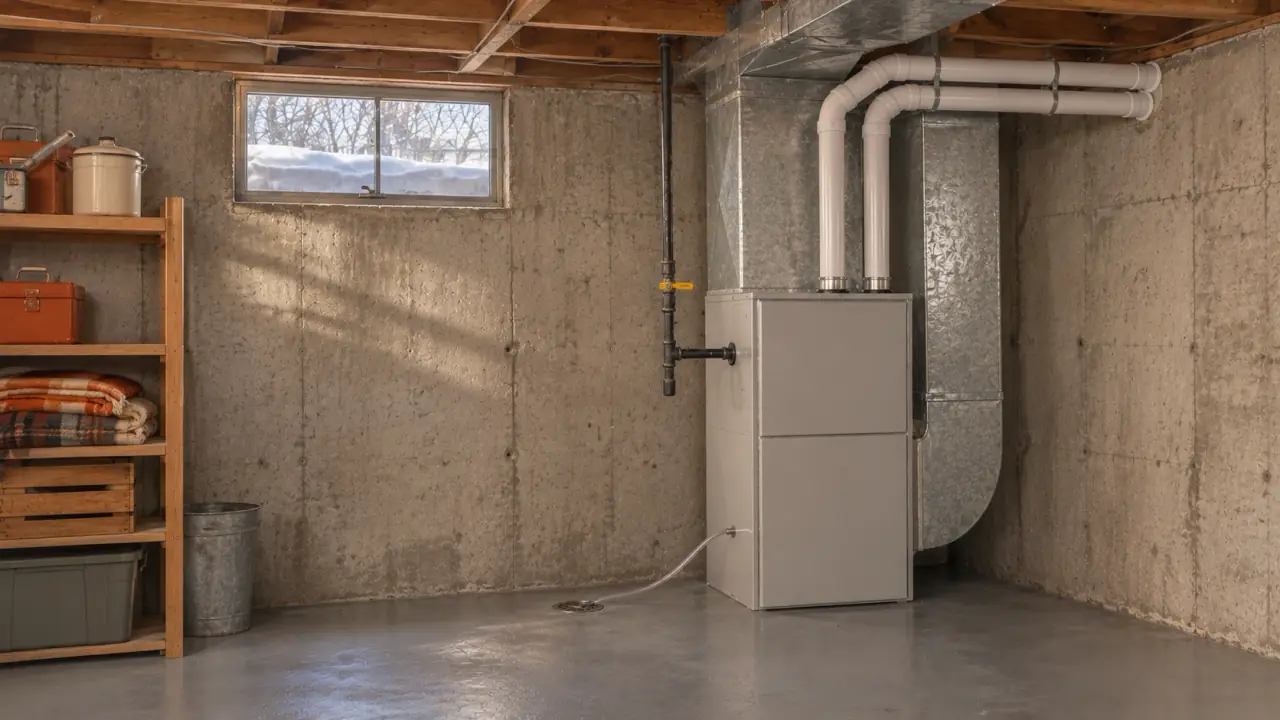
High-efficiency venting needs a good outdoor termination. A condensing furnace vents through plastic pipe, usually out an exterior wall, and draws its combustion air through a second pipe. In a Winnipeg cold snap the exhaust can frost up around the pipe ends and drifted snow can bury them, which shuts the furnace down. Ask where the terminations will go and how they will clear the usual snow line and any windows or doors.
Plan the condensate drain. A high-efficiency furnace produces condensate that has to drain away, ideally to a floor drain or a proper condensate pump, and the line must not run somewhere cold enough to freeze. Ask the installer how the drain will be routed, and whether a pump is needed.
Don't forget the water heater. In many older homes the furnace and the gas water heater share one chimney. When the old furnace is removed, the water heater can be left venting into a flue that is now far too large for it. A competent installer will check this, and it can add work. Ask whether it applies to your house.
If You Are Quoted an 80% Furnace
Older guides, and some quotes, still show mid-efficiency 80% AFUE furnaces as the budget option. For a regular house that option no longer exists: since July 3, 2019, Canada's Energy Efficiency Regulations have required new gas furnaces to be at least 95% AFUE, with 80% units allowed only in narrow cases such as manufactured homes and relocatable buildings (Natural Resources Canada). If a contractor quotes one for your house, ask which exception they think applies, and treat a vague answer as a reason to get another quote.
Some contractors also quote a cold-climate heat pump paired with a furnace as a backup (often called dual fuel). The ranges on this page do not cover that option. If it interests you, ask for a separate quote that includes the equipment, the electrical work and a comparison of running costs, and ask what incentives are currently available. For heat pump quotes, see heat pump installation in Winnipeg.
What Replacing an Old 80% Furnace Gets You in Winnipeg
A 96% AFUE furnace extracts significantly more heat from each cubic metre of natural gas than an 80% unit. In a city with about 5,650 heating degree days per year and a heating season that stretches from October through April, that gap shows up on your natural gas bill every month.
Homes built before 1980 - and there are a lot of them in areas like St. James and Transcona - often have first-replacement 80% AFUE units, or even older and less efficient originals. Upgrading to a high-efficiency unit typically involves switching from a B-vent to PVC flue piping, which adds to installation cost but eliminates the draft-related reliability issues common with older venting systems.
How much you save over your old furnace depends on the size of the house, how much gas you actually burn, how long you plan to stay and what gas costs. A larger detached house with a furnace that runs for most of the heating season gets more from the extra efficiency than a small, well-insulated unit. Rather than rely on a rule of thumb, ask each contractor to estimate the savings from your own recent gas bills and to show the arithmetic.
Efficiency incentives come from Efficiency Manitoba, not Manitoba Hydro. Efficiency Manitoba, the provincial efficiency agency, has run Manitoba's energy-efficiency incentive programs since 2020, replacing the old Manitoba Hydro PowerSmart and Centra Gas programs. Eligible equipment, amounts and application rules change, so check Efficiency Manitoba (efficiencymb.ca) before you sign, and ask the contractor whether the unit you are quoted qualifies and whether anything has to be applied for before the installation date.
What's Included - and What Isn't
A standard furnace installation in Winnipeg should include the furnace unit, labour to remove the old unit and install the new one, connection to your existing gas line and ductwork, new venting appropriate to the unit type, permit fees, and a startup inspection.
What can add cost beyond the base quote:
Ductwork modifications. Homes with cast iron radiator systems or older ductwork that wasn't sized for a modern forced-air unit often need modifications. This can add $500–$2,000 depending on scope.
Gas line upgrades. If your current gas supply line is undersized for the new unit, the technician will need to run new line. Budget $300–$700 for this.
Electrical work. High-efficiency furnaces require a dedicated electrical circuit. If your panel doesn't have capacity or the circuit doesn't exist, add electrical costs on top.
Thermostat. Many installations include a basic thermostat. If you want a smart thermostat, expect to add $150–$350 for equipment and setup.
Permits: A furnace installation needs a provincial gas permit, and a Manitoba Hydro inspector then checks the work. Electrical work needs a City of Winnipeg electrical permit. Always confirm who is pulling each permit before work begins.
Who's Doing the Work Matters
Natural gas equipment in Manitoba has to be installed by a properly licensed gas fitter. This isn't a technicality - improperly installed furnaces are a source of carbon monoxide risk, and unlicensed work creates liability exposure that falls on you as the homeowner.
When getting quotes, ask each company to confirm they'll be pulling the required permits and that the technician doing the work is a licensed gas fitter. A reputable company will answer both questions without hesitation.
Permits, inspection and paperwork
Beyond confirming that a permit will be pulled, ask who is responsible for arranging any required inspection and whether you will receive a copy of the permit and the final sign-off. Keep the permit documents, the model and serial numbers and the warranty paperwork together. A buyer's inspector or your insurer may ask for them later, and a documented, permitted replacement is an advantage when you sell. After the install, make sure the technician has tested the carbon monoxide alarms near the furnace.
How to Compare Quotes Without Getting Lost
When you receive multiple quotes for a furnace replacement, the number that matters most isn't the total - it's what's inside it. Two quotes for $5,200 and $6,800 can represent the same job or completely different scopes.
Ask each company to itemize: equipment model and AFUE rating, labour hours estimated, venting materials included, permit fee, and any exclusions. Once you're comparing apples to apples, the decision becomes clearer. Homeowners in areas like River Heights and Windsor Park often find that mid-range quotes from established local companies consistently outperform both the lowest and highest bids on actual job quality.
If a quote comes in significantly below others, ask what's different. It's usually equipment tier, venting shortcuts, or labour compression. Sometimes it's just an efficient shop - but it's worth knowing.
Many companies offer financing on furnace installs, and the terms vary a lot. If cash flow is a consideration, ask for the interest rate, any promotional period, fees and the total cost of borrowing in writing, and compare that against paying cash. Financing doesn't change the installed price, but it does change what you ultimately pay.
Compare any offer with Manitoba Hydro's Home Energy Efficiency Loan, which can finance up to $7,500 for a high-efficiency gas furnace of at least 92% AFUE, with up to 15 years to repay at 6.7% for the first five years, if you own the home and are approved for credit.
A checklist for every written quote
- Furnace make, model number, AFUE rating, and whether it is single-stage, two-stage or modulating.
- Heating capacity (BTU/h) and a note on how it was chosen (the heat-loss calculation).
- Venting and condensate plan: pipe material, termination locations, drain route.
- Everything included: removal and disposal of the old unit, gas and electrical connections, thermostat, any ductwork changes.
- Permit fee, who pulls the permit and who books any inspection.
- Warranty terms in writing: the manufacturer's parts coverage (including the heat exchanger) and the contractor's own labour coverage, and who registers the warranty.
- Payment schedule, deposit, and the total after any rebate you expect.
- Start date and how long the work will take.
Timeline: From First Quote to a Warm House
A planned replacement usually moves in stages: an in-home visit where the contractor looks at the furnace, ducts, venting and gas line and measures the house; a written quote; your decision; equipment ordering or pick-up from stock; the permit; installation day; and a startup test. The installation itself is the shortest part. As noted in the FAQ below, a straightforward swap can take 4 to 6 hours, while venting changes, ductwork or electrical work can stretch it to a full day.
The part that surprises people is how much time the rest takes in season. During the first hard cold snap and the cold stretches of midwinter, contractors are busy with repairs and emergency replacements, and the model you want may not be in stock. If your furnace is approaching the end of its life, getting two or three quotes in spring, summer or early fall gives you time to compare properly and book at a calmer time. A replacement forced by a breakdown in January leaves you choosing from what is available that week.
Warranty: read it before you sign
There are usually two warranties. The manufacturer covers parts, and coverage for the heat exchanger is often longer than for the rest of the unit. The installer's labour warranty is separate and is set by the company. Ask for both in writing, ask whether the manufacturer's warranty has to be registered to be valid and who will register it, and ask what happens if the heat exchanger fails in year eight: does the warranty cover the labour to swap it?
When to Replace vs. Repair
If your furnace is under 15 years old and the repair estimate is under $800, repair usually makes financial sense. Beyond that - especially for furnaces approaching 20 years in Winnipeg's climate - the calculus shifts. A heat exchanger failure, cracked or corroded, is typically a replacement trigger regardless of age, since repair costs often approach or exceed the value of the unit.
Older 80% AFUE units also come with an opportunity cost: every year of continued operation is a year of higher gas bills. For a furnace that's been running since the mid-2000s in a Wolseley or Fort Rouge home, the efficiency gap versus a modern unit is often meaningful enough to factor into the repair-or-replace decision.
See our guide on signs your furnace needs replacing if you're still weighing the decision.
Directory · 5 companies
Top-rated furnace installation companies in Winnipeg
Independently selected on Google rating, review volume and years in Winnipeg. Every company here is rated 4.7 or higher. Tap one to open its Google listing, with phone number, hours and recent reviews.
-
View on Google
Tradesman Mechanical Services
Winnipeg mechanical contractor for furnaces, air conditioning, heat pumps, water heaters, refrigeration and electrical.
-
View on Google
Abundant Air
Winnipeg heating and air conditioning company. Furnaces, air conditioning and heat pumps.
-
View on Google
Fair Service Heating & Air Conditioning
20+ years in Winnipeg and BBB A+ rated. Furnaces, air conditioning and water heaters.
-
View on Google
Provincial Heating & Cooling
Winnipeg heating and cooling company and Carrier dealer. Furnaces, air conditioning, heat pumps and water heaters.
-
View on Google
Shorty's Plumbing & Heating
Family-owned since 1983. Heating, cooling, boilers, hot water tanks and plumbing, so one call covers both.
Ratings and review counts as shown on each company's Google listing. Compare HVAC companies in Winnipeg side by side.
Common Questions About Furnace Installation Costs
Most furnace installations in Winnipeg fall between $4,500 and $8,000 fully installed, depending on the unit and your home's existing setup. A new gas furnace for a house must be at least 95% AFUE under Canada's energy efficiency rules, so that is what you are pricing. Homes needing ductwork, gas line, or electrical work will land at the higher end.
Yes. A furnace installation needs a provincial gas permit, and a Manitoba Hydro inspector then checks the work. Any electrical work needs a City of Winnipeg electrical permit. A reputable company will pull the permits as part of the job, but confirm this before signing anything.
Yes. Natural gas equipment in Manitoba has to be installed by a properly licensed gas fitter. Ask each company to confirm that the technician doing the job is licensed to do gas work in Manitoba. Unlicensed work creates liability that falls on you as the homeowner.
For many Winnipeg homeowners in detached houses, yes, especially if you plan to stay for years. The city has about 5,650 heating degree days per year, and a new 95–96% AFUE furnace extracts significantly more heat per cubic metre of gas than an old 80% unit (which can no longer be installed new in a house). How quickly the savings add up depends on your home and gas use, so ask for an estimate based on your own gas bills.
Not for most households. As of October 2026, Efficiency Manitoba has no general rebate for a gas furnace. Income-qualified households can upgrade from a standard-efficiency to a high-efficiency gas furnace for $9.50 a month for five years ($25 a month from a mid-efficiency furnace) through its Energy Efficiency Assistance Program. Its other home offers include cold-climate air-source heat pumps ($2,000 centrally ducted, $1,500 ductless) and smart thermostats. Programs change, so check with Efficiency Manitoba before your installation date.
A straightforward furnace swap in a home with existing ductwork and a properly sized gas line typically takes 4–6 hours. Jobs requiring venting changes, ductwork modifications, or electrical work will take longer - sometimes a full day. Ask the company for a realistic time estimate when reviewing the quote.
If your furnace is under 15 years old and the repair is under $800, repair usually makes sense. If the unit is approaching 20 years, has a cracked heat exchanger, or the repair estimate exceeds $800–$1,000, replacement is worth a serious look. A heat exchanger failure is almost always a replacement trigger - repair costs typically approach the value of the unit. Most experienced technicians will give you a straight answer if you ask directly.
Some contractors multiply the furnace's age by the repair quote and look at the total. When it passes $5,000, a replacement quote is usually worth getting. Set it beside the 50% rule, which asks whether the repair costs more than half of a new furnace, and with new furnaces at about $4,500 to $8,000 installed in Winnipeg, half is roughly $2,250 to $4,000. Neither rule settles the question alone, because the diagnosis does.
The furnace make and model with its AFUE rating, the heating capacity and how it was chosen, removal of the old unit, gas and electrical connections, venting and condensate drain, the thermostat, the required permits, a startup test, and written manufacturer and labour warranty terms. Anything excluded, such as ductwork changes, should be listed rather than left out.
Not necessarily on equipment price, but it is usually easier to get quotes, compare them and book a date outside the first cold snap and the midwinter cold stretches, when contractors are busiest with repairs and emergency replacements. A planned replacement also gives you more choice of models.
Not always the same size. A furnace should be sized from a heat-loss calculation for your house as it is now, not simply copied from the old unit. Insulation and window upgrades can mean the old furnace was bigger than the house now needs. An oversized furnace short-cycles and wears out faster.
It can. If your water heater shares a chimney with the old furnace, removing the furnace may leave the water heater venting into a flue that is too big for it. Ask the installer to check this and to include any needed venting changes in the quote.
Roughly $8,000–$15,000 installed, adding the typical Winnipeg ranges of $4,500–$8,000 for a high-efficiency furnace and $3,500–$7,000 for central air on existing ductwork. A combined job can save some labour and makes sure the new AC coil is matched to the new furnace.
Most Winnipeg furnace replacements fall between $4,500 and $8,000 installed, and that range is not split by house size. Square footage alone does not set the price: two 2,000 sq ft homes can need different furnaces depending on insulation, windows and air leakage, which is why a heat-loss calculation matters. Ductwork changes ($500–$2,000) or a gas line upgrade ($300–$700) can move a quote more than the size of the house.
Start planning for it. Furnace makers put a well-maintained gas furnace's typical life at 15 to 20 years, so a 25 year old unit is well past it (see how long furnaces last in Manitoba). Age alone does not mean it has to come out today. Have it inspected, which costs about $100–$180, and get quotes while you still have heat. A cracked heat exchanger or a large repair is the point to replace it rather than fix it.
We do not have a reliable figure for how far Winnipeg furnace prices have moved in 2026, and tariffs are pulling in different directions. On June 30, 2026, Canada gave residential gas furnaces relief from its surtax on U.S. steel and aluminum goods (HRAI). On September 8, 2026, separate counter-tariffs of 15% to 50% began on U.S. goods, including several categories of heating and cooling equipment (Contracting Business). Ask how long each quote's price holds, and compare at least two.